Publications
Our publications adhere to international editorial and research integrity standards. View our Publishing Ethics .
Vol02 Mediation Reframing Peace from War: How words and language bring you peace and happiness
Reframing words to find our happiness and peace: This work analyzes a collection of over 470 expressions from various languages that contain references to war and conflict. The prevalence of such imagery underscores how deeply conflict is embedded in human consciousness and communication. The central thesis is that by actively reframing how these topics are discussed, individuals can shift their focus toward more constructive and life-affirming concepts like hope, joy, and peace.
This act of …
Mediation Reframing Life and Peace from Death and War: How words and language bring you life and peace (Vol. 01)
Introduction: This book is a collection of over 700 English idioms and phrases related to the emotions and realities of death, war, and conflict. The author, David Hoicka, has compiled this list to demonstrate the deep and widespread presence of such imagery within modern culture and society. The central premise is that while death is an inevitable end for everyone, life is the present reality.
The author's primary goal is to shift the conceptual focus of these expressions from death to life. …
Grassroots Mediation: How to Save Lives and Bring Peace, Happiness, Economic Growth in Your Homeland
Preface… Embracing Peace: Mexico's Mothers Challenge Violence with Love
In the heart of Mexico, where the scars of drug violence run deep, an extraordinary movement is redefining the fight for peace. The "Abrazos No Balazos" (Hugs Not Bullets) initiative, born from the grief of mothers who lost their children to cartel violence, stands as a testament to the transformative power of grassroots mediation. This is not just a story of loss; it's a narrative of hope, resilience, and the …
History of Peace: Lessons from 4500 Years Mediating Armed Conflicts
On a misty summer morning in 1807, two of the most powerful men in the world met on a small raft floating in the middle of the Neman River. On one side stood Napoleon Bonaparte, the French Emperor who had conquered much of Europe. On the other was Tsar Alexander I of Russia, whose vast empire stretched from the Baltic to the Pacific. These bitter enemies, whose armies had clashed in bloody battle just weeks before, now faced each other alone on this makeshift floating platform.
The fate of …
Mediation Common Ground in Ukraine Russia: How to Bring Peace, Prosperity and Happiness
Preface: Nikolai Gogol’s “Intermediate Category” for Ukraine and Russia
In the annals of literary history, few figures embody the complex intertwining of Ukrainian and Russian cultures as profoundly as Nikolai Gogol. Born in 1809 in the Poltava Governorate of what is now central Ukraine, Gogol would go on to become one of the most celebrated authors in the Russian language. His life and work stand as a testament to the shared cultural heritage that binds Ukraine and Russia, even as his writings …
Sports Mediation Sports Diplomacy in Ukraine, Russia, and the World: How to Save Lives by Playing Games
Preface: Football for Peace, Sports Mediation in Sub-Sahara Mali, Chad, and Libya
In a war-torn area of Sub-Sahara Africa, Football is a form of mediation bringing peace to warring parties.
In the heart of Africa's Sahel region, where conflict and instability have become all too familiar, an unlikely force for peace has emerged: the beautiful game of football. Across Mali, Chad, and Libya, grassroots initiatives are harnessing the universal appeal of soccer to bridge divides, foster dialogue, …
Confidence Building Measures: Peace, Prosperity & Saving Lives with Mediation CBMs
Preface
Imagine for a moment that you are an explorer, setting out on a journey into uncharted territory. You have a sense of your destination, but the path is uncertain and the risks are high. To navigate the rugged landscape and reach your goal, you will need more than just a map and compass - you will need the trust and cooperation of your fellow travelers, and the wisdom to build bridges across treacherous divides.
Now imagine that the territory is not a physical place, but the complex and …
Multiparty Mediation in a Global Era: Transforming Complex Disputes into Collaborative Solutions
Preface
Conflict is a constant in human affairs, but in today's interconnected world, even local disputes can quickly escalate into complex, multi-party quagmires. A disagreement between two departments can divide an entire organization. A squabble over resources can pit community against community. In this context, traditional methods of bilateral negotiation and mediation often fall short. We need new tools to navigate this treacherous terrain.
This book is a guide for those who find …
Preventive Mediation: The Transformative Power of Early Conflict Engagement and Prevention
The Catalyst: A Personal Crisis in a Fractured Society: The preface opens with a narrative illustrating the acute need for a new approach to social conflict. It centers on Amira, a woman in Tunis whose cousin, Tariq, is arrested during a riot. This riot is not a random act of violence but the culmination of deep-seated societal issues: endemic corruption, economic hardship, and widespread youth unemployment exacerbated by a global pandemic. Tariq, a university-bound student, is implicated when …
Singapore as Model for Ukraine Russia Peace: Proactive Leadership, Mediation and Hard Work
Introduction: Historical Trauma as a Foundation for Peace: This preface establishes the book's central thesis: that a nation's recovery from profound historical trauma can serve as a practical model for peace and reconciliation in other conflict-ridden regions. It uses the specific example of Singapore's experience during and after the Second World War as a foundational case study. The narrative arc of Singapore—from the brutality of occupation to its emergence as a prosperous, cohesive …
Forging Peace Between Europe and Russia: Healing Historical Trauma for Mutual Prosperity and Happiness
A History of Connection: Medieval Integration Royal Marriages as Channels for Exchange Historical narratives of inevitable division between Eastern and Western Europe are contradicted by deep-rooted patterns of cooperation, exemplified by the marriage of Anna Yaroslavna of Kyivan Rus to King Henry I of France in 1051. Anna was not an uncultured outsider but a highly educated, multilingual princess whose literacy surpassed that of her husband and the French court. She signed her name elegantly on …
Mediation and the Children of Abraham: Islam, Christianity and Judaism Building Peace, Prosperity and Happiness
Preface: Historical Foundations of Interfaith Mediation: The preface establishes a historical precedent for interfaith mediation through two key examples from the Crusades. The first is the 1219 encounter between Francis of Assisi, an Italian friar, and Al-Kamil, the Sultan of Egypt, during the siege of Damietta in the Fifth Crusade. Francis’s mission was not one of political diplomacy but a sacred act of peacemaking. He believed the path to ending the conflict was through dialogue, love, and …
City of Peace: Mediation, Prosperity and Happiness
When Neighbors Become Strangers: Global and local divisions are a defining feature of the modern world. In conflict zones like Syria, communities once integrated by shared social events are now segregated by violence. On a smaller scale, political disagreements create silent divisions within families and neighborhoods.
Despite these divisions, acts of connection persist. In refugee camps, Syrian professionals provide services to others regardless of their former allegiances. In post-conflict …
Multi-Track Mediation: Transforming Complex Conflicts in Business, Personal and Community Life
The Limitations of Isolated Mediation Efforts: The conventional model of conflict resolution, known as single-track mediation, operates on the belief that complex disputes can be resolved by focusing on the primary parties and their immediate disagreements. This approach treats conflicts as self-contained problems that can be solved through direct negotiation between key decision-makers. While this method has seen some success, it frequently proves inadequate for the multifaceted conflicts …
How Conflict Resolution Evolves Over 4 Stages: Total War, to Champion Combat, to Symbolic Combat, to Mediation
Conflict resolution has progressed through an evolutionary sequence, moving from primitive, destructive methods toward sophisticated, collaborative approaches. This development reflects fundamental advances in human cognitive and social capabilities.
The primary evolutionary framework consists of four stages, which parallel increasing levels of neurological engagement:
Total War: An indiscriminate, destructive approach driven by the brain's most primitive, fear-based responses (amygdala). …
Mediation Dreams of Peace: Learning from Averroes, Maimonides, Aquinas, Confucius, Buddha, Bhagavad Gita Krishna, and Laozi
Journey to Wisdom: A mediator, facing a profound professional failure after a high-stakes manufacturing plant mediation collapsed, seeks a new approach to conflict resolution. The failure occurred because standard techniques like active listening and reframing were dismissed by parties entrenched in mutual accusation. The mediator recognized that the core problem was an inability to bridge legitimate but competing concerns, necessitating a fundamental transformation rather than a mere refinement …
The Art of Mediation: Fresh Ideas from Different Cultures for Peace, Prosperity and Happiness
Preface: One Beggar Helping Another Find Bread: The central metaphor for mediation is a story of two beggars. One, who has a piece of bread, shares it with another who is starving. This act does not solve their poverty but allows both to survive. Mediation operates in this spirit: it is not an expert fixing a problem for the powerless, but one person sharing a specific capacity—the ability to facilitate dialogue—with others who need it.
This capacity is fundamentally human, not exclusively …
War is Obsolete: How to Bring Peace, Happiness, Prosperity to Your Homeland, Instead of War and Death
War is Obsolete - How to bring Peace, Happiness, Prosperity to your Homeland For political leaders exhausted by warfare's costs, military commanders watching young soldiers die for objectives that cannot be achieved, and decision-makers searching at 3am for alternatives to continued bloodshed: this executive summary provides evidence-based analysis proving that modern warfare cannot accomplish strategic objectives and that mediation offers viable paths protecting your core interests while ending …
Healing Intergenerational Trauma in Ukraine Russia: Mediation for Peace, Prosperity and Happiness
Healing Intergenerational Trauma in Ukraine Russia - Mediation for Peace, Prosperity and Happiness: For political leaders whose decisions shape whether thousands live or die, for military commanders evaluating paths beyond continued combat, for advisors searching at three in the morning for alternatives no one seems to see, for civil society leaders maintaining humanity amid horror, and for ordinary people trapped in conflicts they did not choose: this executive summary addresses why conflicts …
Swords into Plowshares: Helping Defense Industries Become Profitable with Peace
The current conflict between Ukraine and Russia has killed hundreds of thousands. Behind the geopolitical analyses and strategic assessments lies a deeper reality that most commentators miss: inherited trauma operating beneath conscious awareness, passed down through generations, compelling repetition of patterns that serve no one's true interests. Until this trauma layer is recognized and addressed, even the most skillfully negotiated agreements will prove fragile, and the cycle will continue …
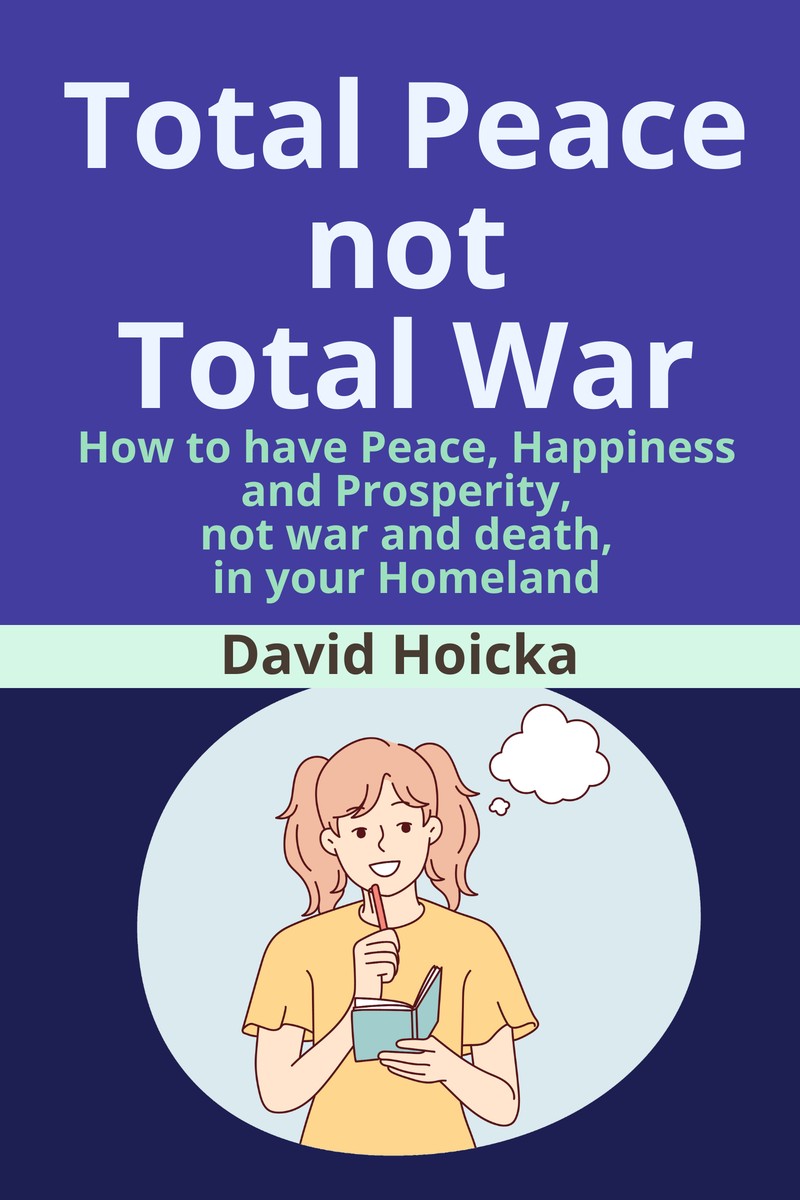
Total Peace not Total War: How to Have Peace, Happiness, Prosperity, Not War and Death, in Your Homeland
Total Peace Not Total War: A Practical Guide to Building Harmony David Hoicka's new book offers a refreshing alternative to conflict-driven thinking. Rather than accepting war and division as inevitable, he presents actionable strategies for creating peace, happiness, and prosperity in our communities. Think of it as a practical handbook for anyone tired of endless arguments—whether in families, workplaces, or nations. Hoicka draws on mediation expertise to show how shifting from "us About …